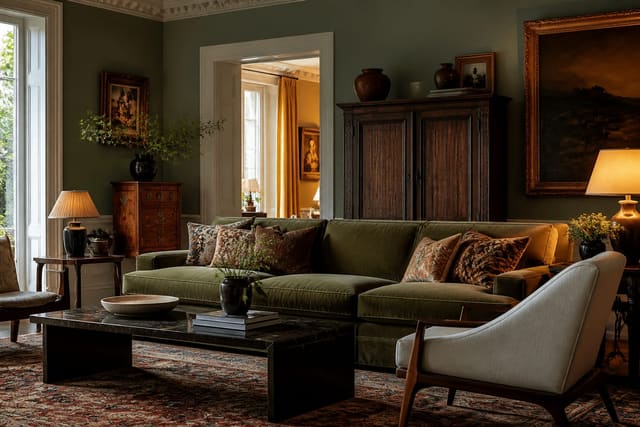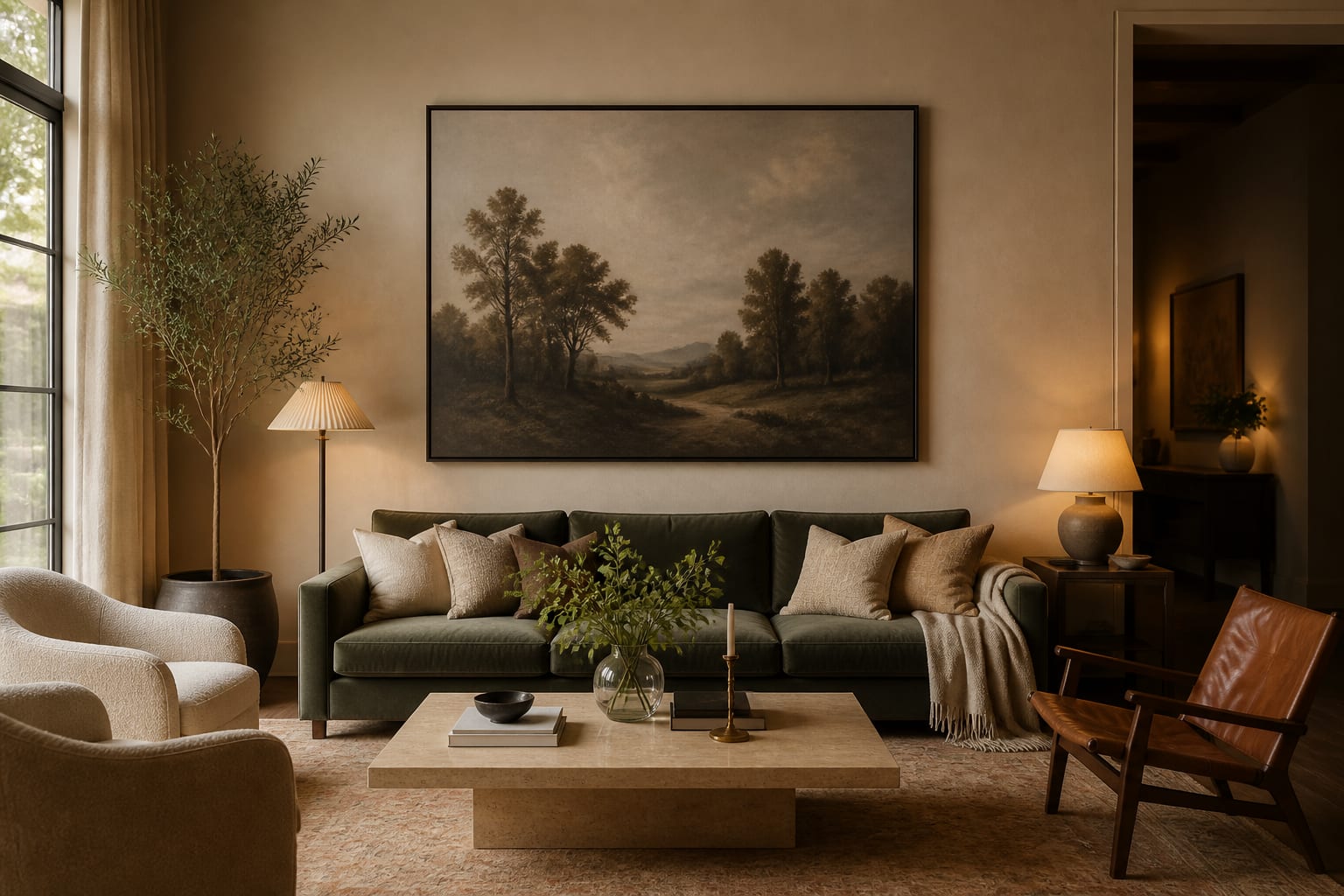
Fill roughly two-thirds to three-quarters of the wall or furniture width with your artwork, and center it at 57 to 60 inches off the floor, the standard eye line. Most people go too small and hang too high, leaving art floating in a blank field. Once scale relates correctly to the wall and furniture, even an inexpensive print looks deliberate.
What is the two-thirds rule for art size?
Measure the wall or the furniture below it, then aim for the art, or the combined arrangement, to span about two-thirds to three-quarters of that width. Over a 72-inch sofa, that's roughly 48 to 54 inches of art, as one canvas or a cluster of frames. Anything narrower than half the sofa width looks undersized.
The rule works because your eye reads the relationship between objects, not their size in isolation. A 30-inch print can feel generous on a narrow wall and tiny over a sectional. This is also why dim walls swallow art easily, the same principle behind helping a dark room feel fuller and more finished: larger, lighter pieces hold a shadowy wall that small ones vanish into.
Favor the upper end of the range for confidence. A piece at three-quarters of the wall width commits to the space and makes a room feel resolved, while two-thirds leaves quieter breathing room. Decide which feeling you want before shopping, since it changes the frame size and budget more than the artwork itself.
How high should you hang art, and how much space should you leave?
Center the artwork at 57 to 60 inches off the floor, measured to its vertical midpoint, not its top edge. That eye line is why gallery hangs feel comfortable and home hangs often feel a foot too high. Over furniture, leave 6 to 10 inches between the sofa or console top and the bottom of the frame to keep the two connected.
Gallery walls follow the same math at a group level. Keep a consistent 2 to 3 inch gap between frames so the cluster reads as one block, then apply the two-thirds-width and 57-to-60-inch-center rules to that whole block. Mixed frame styles work if spacing stays disciplined, the same way bringing more than one aesthetic into a room holds together when one element stays consistent. Lay frames on the floor first and check:
- The arrangement covers at least two-thirds of the furniture or wall width.
- The visual center of the group lands near 58 inches off the floor.
- Gaps between frames stay within roughly half an inch of each other.
- The outer edges form a clean rectangle or oval, not a ragged outline.
How do you size art for tricky or dual-purpose walls?
Tall, narrow walls call for vertical pieces or a stacked pair echoing the space's proportion. Wide, low walls behind a credenza want horizontal art or a measured row of frames. In rooms with double duty, size to the largest likely furniture layout; a flexible single-room setup built around two functions works better with one large, repositionable piece than a fixed gallery wall.
Staircases and narrow hallways need their own rule. On a stair, follow the handrail's slope, keeping each frame's center about 60 inches above the tread directly below. In a hallway under 4 feet wide, you can't step back far enough for one huge canvas, so a vertical run of medium frames at a tight 2-inch gap works better.
What are the most common art-sizing mistakes?
Hanging too high and buying too small usually travel together. If a frame's bottom sits more than 10 inches above the sofa back, drop the center to the 57-to-60-inch line. A 16-by-20-inch print over a full sofa covers maybe a quarter of the width and reads as an accident.
Other frequent errors:
- Ignoring weight. A 40-by-60-inch framed piece with glass can run 30 to 50 pounds; use a stud or rated anchor, not a single picture hook.
- Uneven gallery spacing. Gaps drifting from 2 to 5 inches make a wall look careless regardless of the frames themselves.
- Centering to the wall instead of the furniture when furniture sits off-center, which throws the whole grouping off by a few inches.
- Climbing art upward on tall ceilings. An 11-foot wall doesn't move the human eye line; the center still belongs near 58 inches, with empty space left above.
Matting and frame width quietly change apparent size. A 3-inch mat can add 6 inches of presence to a small print, pushing it into the right range for far less than buying larger artwork.
How can you preview artwork size before buying?
Art is expensive to get wrong, and you usually can't tell if a piece is too small until it's already on the wall with holes drilled. Re-Design fixes that: upload a photo of the wall and furniture, and the AI design tool shows a large single canvas, a gallery cluster, or an oversized statement piece scaled to your real dimensions.
Generate a 36-inch option and a 54-inch option in the same spot to see which one actually fills the space. That preview turns a regret-prone purchase into a confident one, since you're judging scale against your own room and light instead of a flattering gallery photo.
Frequently Asked Questions
What size art should I buy for a sofa?
Aim for the art, or the arrangement, to span roughly two-thirds to three-quarters of the sofa's width. Over a 72-inch sofa, that's about 48 to 54 inches of combined art. Leave 6 to 10 inches between the sofa top and the frame's bottom edge.
How high should I hang a picture on the wall?
Center the artwork's vertical midpoint at 57 to 60 inches off the floor, the standard museum eye line. This holds true even in rooms with tall ceilings, since it matches average human eye height, not ceiling height.
How much space should be between gallery wall frames?
Keep a consistent 2 to 3 inches between frames so the whole arrangement reads as one shape. Gaps that vary from 2 to 5 inches make the wall look disorganized even with attractive individual pieces.
Can a mat make small art look bigger?
Yes. A 3-inch mat can add roughly 6 inches of visual presence to a print, often pushing an undersized piece into the correct proportional range for less money than buying a larger artwork outright.
How do I know if my art is too small?
If it covers less than about half the width of the wall or furniture below it, or if there's more than 10 inches of gap above the furniture, the piece is likely undersized. Sizing up or adding a wider mat usually fixes it.